With the advances now available in Book Bolt Studio’s newer story-creation features, it’s easier than ever to generate children’s stories quickly. But if you want to build a book that parents trust and kids ask for again, one story engine keeps outperforming almost everything else:
The kindness plot.
Not “be nice” as a slogan. Not a lecture. Not a gold-star morality poster.
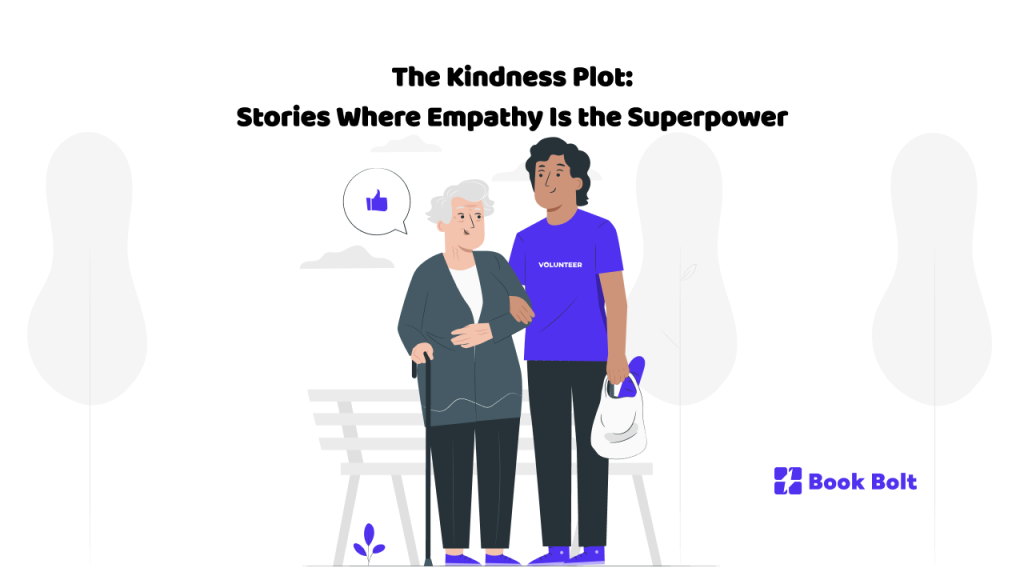
A kindness plot is a story where the hero wins—not by being the strongest, loudest, or most clever—but by doing something quietly powerful:
They notice someone else’s feelings.
They choose empathy.
They repair instead of punish.
They help instead of win.
And in kid lit, that’s not soft. That’s a superpower.
Because kids live in a world where they’re constantly bumping into other people’s emotions—siblings, classmates, adults with moods they don’t understand. A kindness plot gives them a map for navigating that world without turning into a doormat or a bulldozer.
It teaches the rarest skill of all:
How to be kind and still have agency.
Why kindness plots endure (and why they sell)
There’s a reason parents reach for these stories over and over: they don’t just entertain. They help.
A good kindness plot delivers three things at once:
- Emotional safety: the book feels trustworthy, not cynical
- Modeling: the child sees how empathy works in action
- Reread comfort: the ending restores connection, which kids crave
And kids respond to it more than many adults expect. Not because kids are saints—but because kids are constantly learning the social rules of the world. They’re practicing.
A kindness plot is basically practice with a warm ending.
What a kindness plot is (and what it isn’t)
A kindness plot is not “the hero is perfect.”
In fact, the best kindness-plot heroes are messy:
- they misunderstand
- they get jealous
- they blurt the wrong thing
- they act before thinking
- they feel embarrassed afterward
That’s what makes the empathy moment meaningful. Kindness matters most when it costs something—pride, comfort, the desire to “be right.”
A kindness plot is also not “the villain gets a hug and everything is fine.”
Empathy doesn’t mean excusing bad behavior. It means understanding what’s underneath it—and choosing a response that repairs instead of escalates.
The kindness plot structure (simple, reusable)
Most kindness stories follow a shape that’s incredibly kid-friendly:
- A social friction moment
Someone is excluded, misunderstood, teased, ignored, or overwhelmed. - A first reaction that doesn’t help
The hero reacts like a normal human: defensive, annoyed, embarrassed, jealous. - A small moment of noticing
The hero sees the other person’s face, body language, or situation and realizes: “Oh. There’s something going on here.” - A choice point
The hero can win, mock, avoid, or dominate… or they can choose empathy. - A kindness action
Not a speech. An action: sharing, helping, inviting, repairing, apologizing, making room. - A restored world
The social weather changes. The room feels safe again.
That arc is the kindness plot. You can write a thousand stories on it, and it’ll still feel fresh if the characters and setting are vivid.
Empathy as superpower: the “moves” kids can copy
If you want your kindness plot to feel actionable (not preachy), give the hero one or two empathy moves a child can imitate.
Here are a few that work beautifully in picture books:
- The pause: “Wait… what happened?”
- The question: “Are you okay?” / “Do you want to play?”
- The invitation: “You can sit with us.”
- The repair: “I didn’t mean that. I’m sorry.”
- The tiny help: picking up dropped items, saving a seat, sharing a tool
- The reframe: “Maybe they weren’t being mean… maybe they were scared.”
Notice: these aren’t speeches. They’re behaviors. That’s what makes the lesson stick.
The secret sauce: kindness plots need dignity, not pity
A common mistake is writing kindness as pity:
- “Poor you, let me rescue you.”
Kids sniff that out fast, and it can feel gross.
Strong kindness plots are about dignity:
- “I see you.”
- “You belong.”
- “I won’t make you smaller to make myself bigger.”
That’s why the best kindness plots often end in partnership—two characters solving something together—rather than a hero rescuing a helpless character.
How to keep a kindness plot from feeling corny
If you’re worried your kindness story will feel too “after-school special,” here are three practical fixes:
- Keep the conflict real and specific.
Not “be kind.” Instead: “Someone gets left out at recess” or “A kid’s lunch spills.” - Make the hero’s first reaction imperfect.
Let them be human. Then let them grow. - Show consequences and repair.
Kindness isn’t magic fairy dust. It changes the situation because it changes behavior.
When you do those three things, the kindness plot feels like life—not like a lecture.
Using Book Bolt Studio without losing the human heart
AI-assisted drafting can be great for generating story options quickly, but kindness plots live and die on tone. They need warmth without syrup, clarity without preaching.
A good workflow:
- You decide the empathy moment (the “choice point”) and the repair ending
- Studio helps draft variations of scenes and dialogue
- You revise for voice so the kindness action feels earned and specific
If a line sounds like a poster (“Always be kind!”), turn it into a moment:
- a look
- a pause
- a small action
- an apology that costs pride
That’s where the power lives.
Final thought
In kid lit, empathy is not weakness. It’s a skill.
A kindness plot teaches children something they’ll use for the rest of their lives: how to notice, how to choose, how to repair, and how to make a space feel safe again.
That’s not just a good story engine.
That’s a classic.