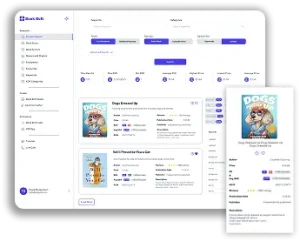
Book Bolt has made it easier than ever to create and upload story books quickly—and with Book Bolt Studio’s newer story-focused capabilities and AI-assisted creation tools in the mix, the speed of production is no longer the main limiter for most creators. The real limiter is stickiness: will a reader (and their parent) come back for another book… and another… and another?
That’s where “series magic” becomes your unfair advantage.
Because the most durable children’s stories aren’t just good once. They create a returnable world—a place kids want to visit again the same way they want the same bedtime routine, the same favorite stuffed animal, the same comfort show.
A series isn’t just a marketing tactic. It’s a storytelling structure that taps into the psychology of rereads.
Let’s break down how classics do it—and how you can apply it even if you’re only planning one book right now.
Series aren’t built on plot. They’re built on familiarity.
Adults often think a series means “bigger plots.”
Kids usually want the opposite.
They want:
- the same world
- the same vibe
- the same kind of problem
- the same emotional safety
- with one new twist per book
That’s why series stick. Each new installment feels both:
- new enough to be exciting
- familiar enough to be comforting
Think of it like a favorite restaurant: you go back because you trust the experience, not because the menu is completely different every time.
Creator rule:
If you want series potential, lock your world promise before you chase “bigger story.”
The “World Promise”: what the reader can count on every time
The fastest way to make a series feel real is to define the promise in one sentence:
- “Every story is a cozy adventure in a safe place.”
- “Every story is a small problem solved with kindness.”
- “Every story is a spooky-cute mystery that ends warm.”
- “Every story is about a curious character learning one life skill.”
That promise becomes your North Star.
When a child asks for the next book, what they’re really asking is:
“Can I have that feeling again?”
Series magic ingredient #1: a home base
Classic series almost always have a home base:
- a neighborhood
- a school
- a forest
- a burrow
- a little town
- a single “special” room or shop
The home base creates continuity without effort. It’s instantly recognizable. It’s easy for kids to picture again.
Practical move:
Design your world like a toy playset. A few distinct locations that can generate endless episodes:
- The Treehouse
- The Pond
- Grandma’s Kitchen
- The Little Library
- The Backyard Kingdom
- The Night Market
- The Cozy Corner Store
You don’t need ten locations. You need 3–5 that feel owned.
Series magic ingredient #2: a cast with clear “jobs”
A series becomes addictive when the cast feels like a little community, not a rotating parade.
Each character should have a clear job in the emotional ecosystem:
- The Brave One
- The Worrier
- The Inventor
- The Rule-Follower
- The Sweetheart
- The Grump with a Soft Center
- The Younger Sidekick
- The Wise-but-weird mentor
Kids love when a character behaves predictably (in a good way). They learn the personalities and start anticipating reactions. That anticipation is comfort.
Creator move:
Make a “cast grid” for your series world:
- Character
- One dominant trait
- One vulnerability
- Their job in the group
- One recurring comedic habit
That grid alone can generate 20 story premises.
Series magic ingredient #3: repeatable structure
The reason episode-based stories work so well for children is that structure becomes a rhythm.
A very common “classic structure” looks like this:
- We start in the familiar world
- A small problem appears
- The hero tries a quick fix (fails)
- The hero tries again (worse consequence)
- The hero changes behavior / asks for help
- The problem resolves
- We return to safety, often with a little tag joke or cozy closure
It’s not formula—it’s a lullaby with a plot.
Creator move:
If you want a series, don’t reinvent structure every time. Reinvent the problem.
Series magic ingredient #4: “small stakes, big feelings”
Kids don’t need galaxy-saving stakes to feel invested.
A series thrives on problems like:
- losing something
- making a mistake
- being embarrassed
- misunderstanding a friend
- being scared of a new thing
- wanting to prove yourself
- trying to be included
These are the problems kids actually live with.
When a series stays in that lane, it becomes a mirror for their real emotional world—without overwhelming them.
Creator rule:
Keep the stakes small, but make the feelings honest.
Series magic ingredient #5: a signature tone
Tone is the brand.
The quickest way to kill series cohesion is tonal whiplash:
- book one is cozy
- book two is chaotic
- book three is scary
- book four is preachy
Classic series feel like a consistent “weather pattern.”
Choose your tone family:
- cozy
- silly
- adventurous
- gentle spooky
- wholesome mischief
- calm bedtime
Then keep it steady.
Creator move:
Write a “tone pledge” for your series:
- “No cruelty.”
- “No hopeless endings.”
- “Scary moments always shrink.”
- “Humor is never mean.”
- “The world is safe even when it’s exciting.”
Kids trust tone.
How to build a series even if you only have one book today
This is the best trick in the business:
You don’t need to write “Book 1 of 12.”
You just need to write a world that could hold 12.
Here’s a simple approach:
Step 1: Create the world container
Name the place. Give it 3–5 key locations.
Step 2: Define the cast
3–6 characters is plenty.
Step 3: Create a list of “episode engines”
These are repeatable problems:
- “Someone misunderstands a rule”
- “Someone is afraid of something new”
- “Someone wants to impress and overdoes it”
- “Someone loses something important”
- “Someone learns a skill”
- “Someone tries to help and makes it worse”
Step 4: Write Book One like a standalone
But end with the feeling: “More adventures could happen here.”
That’s it.
You’ve quietly built series potential without promising a giant pipeline you can’t deliver.
Where Book Bolt fits into series-building (without making it soulless)
Tools that speed up production are a gift when you’re building a consistent world—because series success depends on consistency:
- consistent character look
- consistent palette
- consistent layout rhythm
- consistent tone
When you’re using Book Bolt Studio (and AI-assisted creation tools) the advantage isn’t “let it invent the series.”
The advantage is:
- you can lock your world (characters, palettes, templates)
- then produce faster without rebuilding assets every time
Healthy creative split:
- You define: world promise, cast jobs, tone pledge, repeatable structure
- The tool accelerates: layout, visual creation, production workflow
- You refine: continuity, voice, and “does this feel like home again?”
Series readers don’t want novelty. They want familiarity with forward motion.
A quick checklist: is your story world series-ready?
Before you publish, ask:
- Do I have a clear home base?
- Do my characters have distinct “jobs”?
- Is the tone consistent and repeatable?
- Can I imagine 10 small problems in this world?
- Would a child want to return here at bedtime?
If yes, you’ve got the foundation of series magic.
Final thought: the real product is the return trip
A one-off book can sell.
A series world can build momentum—because it gives children something rare and valuable:
A place they can return to and feel safe, understood, and entertained again.
If you build that kind of world, the “next book” stops feeling like a sales goal.
It becomes the natural next bedtime request.